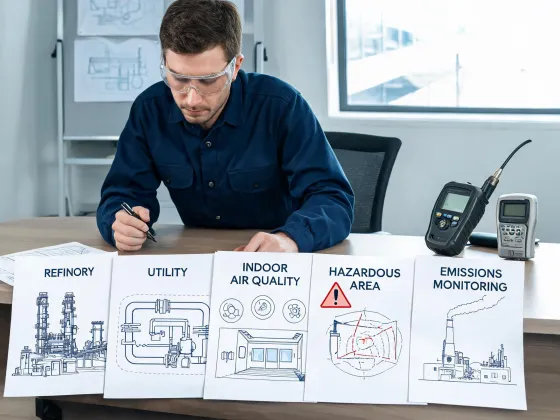
IND-C guided cards

Testo industry guidance for environmental and gas monitoring buyers

Each industry below comes from the approved seed list. The goal is to help buyers translate site language into measurement language before model numbers, accessories, and certificates are compared.

Application engineer mapping gas monitoring requirements

Refinery & Petrochemical Safety

Fixed and portable combustible or toxic gas detection must fit the work permit, the zone classification, and the response-time expectation. A confined-space team may ask for oxygen, LEL, hydrogen sulfide, and carbon monoxide in one portable unit. A process unit may need fixed heads near a skid or boundary. Testo helps the buyer separate personal safety, area monitoring, and documentation needs so each instrument is quoted with the correct accessories and service plan.

Review gas detection needs

Utility & District Metering

Smart water and heat meter projects require more than a flow range. Billing use can require MID language, EN 1434 references, communication planning, and a record of how the meter will be commissioned. Testo frames the conversation around the network, the approval region, and the reporting routine. That structure helps utility teams avoid mismatched meters that look similar in a catalog but fail the administrative requirement.

Discuss metering evidence

Indoor Air Quality

CO2, TVOC, humidity, temperature, and particulate monitoring are often requested during building certification, commissioning, or occupant-comfort investigations. Testo helps facility teams state the measurement interval, display need, logging method, and acceptance criteria before instruments are selected. The guidance is practical because IAQ projects often involve consultants, facility managers, and HVAC technicians who each look for different proof.

Plan IAQ measurement

Hazardous Area Operations

ATEX and IECEx requirements must be named precisely. A phrase such as safe for explosive atmospheres is too vague for procurement or safety review. Testo keeps the zone and marking visible, including examples such as Ex ia IIC T4 Ga for Zone 0 when the use case requires it. That helps teams separate personal-safety wearables, portable checks, and fixed detection points without blending them into one unsafe assumption.

Check hazardous-area fit

Environmental Compliance

Continuous emissions monitoring, ambient stations, and stack analysis projects depend on consistent records. The buyer may need calibration gas planning, analyzer service intervals, data retention, and a reporting format that matches the regulator. Testo positions instrument selection as part of that reporting chain, so the equipment, service, and documentation package can be reviewed together.

Review compliance monitoring

Selection checklist

Five questions make the industry match clearer

Start by naming the environment, measured value, and consequence of a bad reading. Then define where the record will go. A service team may need a fast screen, while an environmental manager may need evidence that survives a regulatory submission. The same product family can serve both cases, but the accessories, calibration points, and documentation package can differ sharply.

  • Which gas, physical value, or environmental parameter is being measured?
  • Is the instrument portable, fixed, panel-mounted, or part of a metering network?
  • Does the site require ATEX/IECEx, MID, EN 1434, or another named approval?
  • What calibration interval and traceability chain will be accepted by QA?
  • Who will use the data after collection, and in what format?

Industry matching

Send the application before you send the model number.

Testo can help connect industry context to instrument range, approval language, and calibration planning.